

1. Production Process
Hot-Rolled I-Beams:
Manufactured by rolling steel billets at high temperatures (typically above 1,100°C), followed by natural cooling. This process refines grain structure and eliminates internal stresses, making it suitable for large-scale structural applications.
Key Feature: High-temperature shaping ensures uniform microstructure and better toughness
Cold-Rolled I-Beams:
Processed at room temperature using pre-hot-rolled steel. Cold rolling involves additional steps like acid washing, annealing, and precision shaping, resulting in tighter dimensional tolerances.
Key Feature: Cold working increases yield strength by up to 20% through strain hardening but reduces ductility
2. Mechanical Properties
Hot-Rolled:
Lower yield strength (e.g., Q235B: 235 MPa) but higher ductility and impact resistance, ideal for dynamic load-bearing structures like bridges and building frames
Superior torsional resistance due to uniform residual stress distribution (film-type stress)
Cold-Rolled:
Higher yield strength (e.g., 400–700 MPa) but reduced elongation. Prone to brittle fractures under heavy loads.
Allows local buckling to optimize post-buckling load capacity, suitable for lightweight or non-load-bearing components
3. Surface Quality
Hot-Rolled:
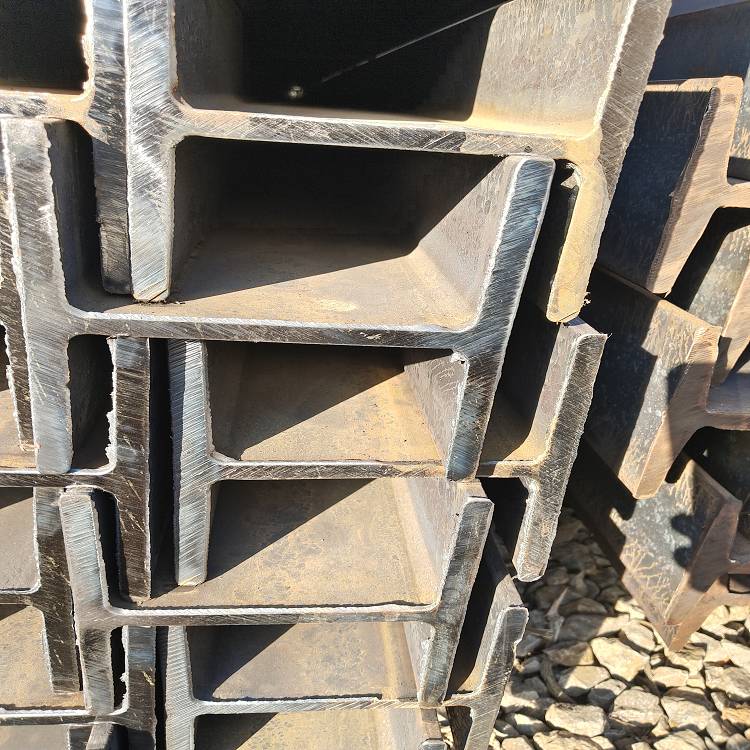
Rough surface with iron oxide scales (from high-temperature oxidation), requiring shot blasting or galvanized treatment for corrosion resistance
Cold-Rolled:
Smooth, polished surface (Ra ≤ 0.4 μm) with no oxide layers. Often coated with zinc or paint for enhanced durability in precision applications
4. Dimensional Accuracy
Hot-Rolled:
Larger dimensional tolerances (e.g., height deviation ±2–4 mm, thickness ±0.5–1.0 mm). Suitable for large-section profiles (e.g., 100–630 mm height)
Cold-Rolled:
High precision (±0.02–0.1 mm) for small to medium sections (e.g., 50–160 mm height). Commonly used in machinery and decorative engineering
5. Applications
Hot-Rolled:
Heavy-duty structures (e.g., industrial plants, bridges), mining equipment, and high-temperature environments (e.g., boilers)
Cold-Rolled:
Lightweight frameworks, precision machinery parts, solar panel brackets, and architectural decorations requiring fine finishes
Summary Table
| Parameter | Hot-Rolled I-Beams | Cold-Rolled I-Beams |
|---|---|---|
| Production Temp. | 1,100–1,250°C | Room temperature |
| Surface | Rough, oxidized | Smooth, polished |
| Yield Strength | 235–460 MPa (Q235B–Q355B) | 400–700 MPa |
| Key Advantage | High toughness, cost-effective | Precision dimensions, high surface quality |
| Typical Use Cases | Bridges, heavy machinery, construction | Solar支架, automotive parts, lightweight structures |
For technical specifications or certification details (e.g., ASTM, EN, JIS), consult industrial standards or manufacturers' documentation.


